LPG use & efficiency

From our channels
Practical educational posts on gas geyser sizing, solar backup, water pressure, LPG use, maintenance and homeowner safety. Select a thumbnail to read the full guide. Posts are ordered newest first.
- Water flow & pressure
- Geyser sizing & selection
- Solar & off-grid hot water
- LPG use & efficiency
- Maintenance & performance
- Safety & replacement
Geyser sizing & LPG
How long will your gas bottle last
· HABCO South Africa
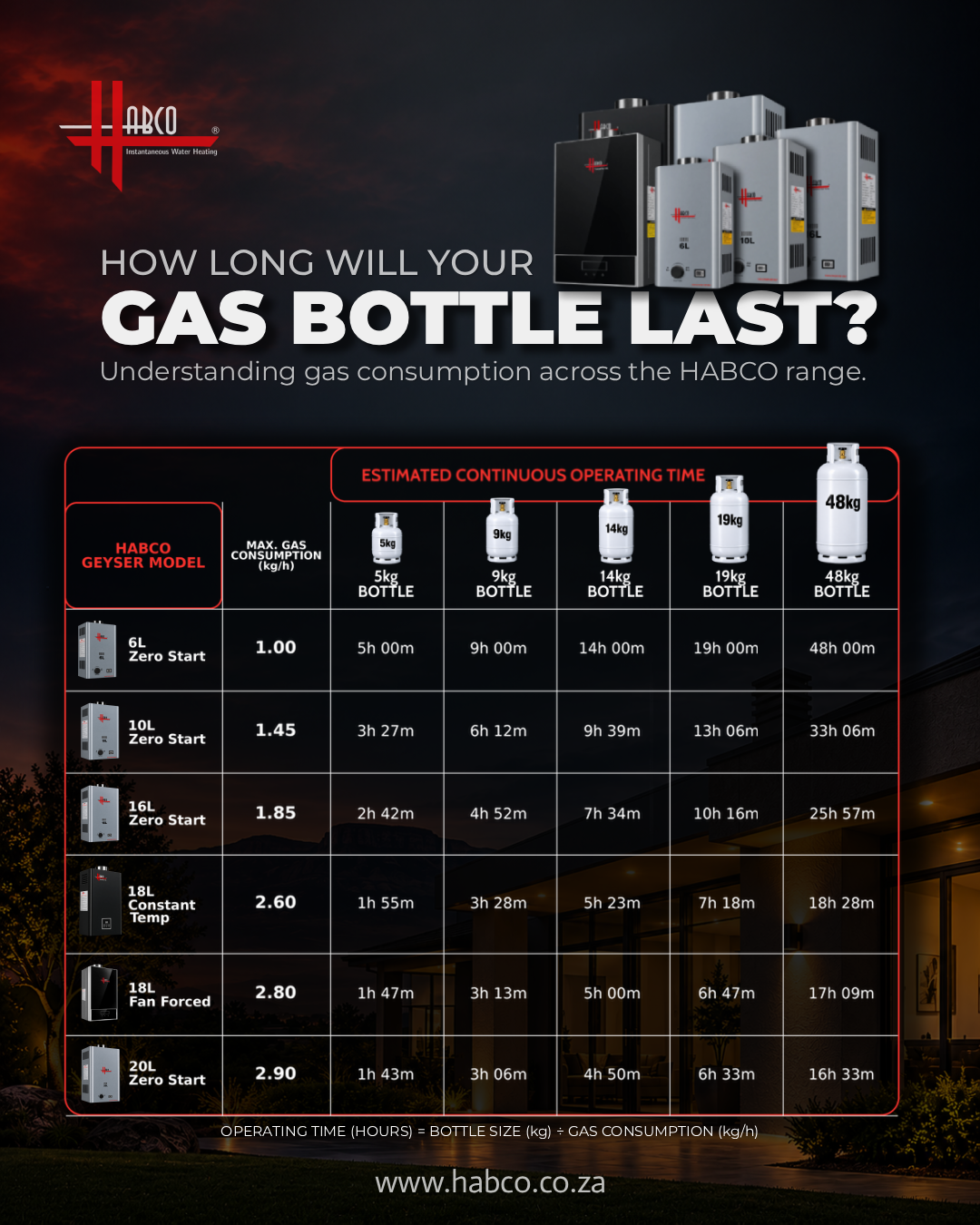
How long will a gas bottle last, and what size bottle should you use with your gas geyser? The answer starts with understanding how much gas your geyser can use, and how much hot water your household actually needs.
The chart shows the maximum rated gas consumption for each HABCO model, measured in kilograms per hour. This is the amount of gas the appliance can use when operating continuously at its maximum rated input, as specified by the manufacturer. That figure is used for gas supply design and for consistent model comparison; everyday use is typically lower because the burner only runs when hot water is drawn.
The operating times are calculated by dividing the amount of gas in the cylinder by the geyser's maximum hourly consumption.
Take the HABCO 20L Zero Start as an example. Its maximum consumption is 2.9kg per hour. Divide a full 19kg cylinder by 2.9, and you get approximately 6 hours and 33 minutes of continuous operation.
That is the theoretical worst-case estimate. It assumes the geyser runs continuously at maximum consumption. In everyday use, the burner only operates when hot water is drawn, and gas consumption changes with water flow, incoming water temperature and the temperature you select.
But how do you choose the right geyser and cylinder for your home?
Let's consider a couple living in a house with one bathroom and a kitchen. They have a small shower in the bathroom and a kitchen sink. For sizing purposes, let's assume the shower uses around 8 litres per minute and the kitchen tap around 4 litres per minute. If both are running at the same time, the geyser needs to supply approximately 12 litres of hot water per minute. While a 10L model may be suitable for lower demand or one outlet at a time, we'd generally look at a 16L HABCO model for this setup. It provides more capacity to accommodate simultaneous use, without having to size the geyser right at its maximum output. The final selection still depends on the required water temperature, incoming water temperature and the model's rated performance.
Now let's look at the gas bottle. Assume two eight-minute showers each day, plus five minutes of hot-water use at the kitchen sink. With water heated to around 40°C for the showers, the estimated daily gas requirement could be in the region of 0.4–0.5kg. On that basis, a 19kg cylinder could last approximately five to six weeks.
This is an illustrative estimate, not a guarantee. Actual consumption will depend on incoming water temperature, flow rates, shower duration, kitchen use and the appliance's operating conditions. Other household hot-water use will also affect how long the cylinder lasts.
The important thing is that choosing a geyser starts with your household's hot-water demand, especially which outlets may run at the same time. Choosing a cylinder then comes down to your expected usage and the gas supply requirements of the appliance.
Maximum consumption gives us the starting point. Understanding your actual usage helps put those figures into perspective.
In our next post, we'll look at practical ways to reduce LPG consumption and make your gas go further.
For more information about LPG, gas geysers and the HABCO range, visit www.habco.co.za.
Sources and further reading
- Maximum rated LPG consumption figures for HABCO models are taken from current HABCO technical specifications (manufacturer rated input).
- Cylinder runtime examples are illustrative worst-case continuous-operation calculations (cylinder mass ÷ maximum kg/h). Actual household use is intermittent and lower.
LPG & combustion

The science behind the blue flame
· HABCO South Africa
Have you ever wondered why a gas flame is blue, or what actually happens when LPG burns?
LPG is made mainly of propane and butane. When these gases burn with enough oxygen, they produce heat, carbon dioxide and water vapour. This is called complete combustion.
The blue colour comes from excited chemical particles releasing energy as light. A steady blue flame is generally a good sign that the burner is mixing gas and air correctly.
But there's another reason this little blue flame deserves some attention.
Compared with traditional solid-fuel cooking fires, LPG can produce substantially fewer harmful particulate emissions at the point of use.
A 2019 field study in Nepal measured emissions from LPG and biogas cooking stoves during normal household use, and compared them with wood stoves in the same households. On a fuel-energy basis, wood stoves emitted about 50 times more fine particulate matter (PM2.5) than biogas, and hundreds of times more elemental carbon. LPG emissions were similarly low relative to wood.
That study measured cooking stoves, not gas geysers. The comparison is still useful because it shows how controlled LPG combustion can reduce smoke and fine particles compared with traditional open solid-fuel fires. It does not measure HABCO appliances directly.
Fine particles (PM2.5) can travel deep into the lungs. Carbon monoxide is poisonous, and black carbon from smoky fires also contributes to climate warming.
LPG remains a fossil fuel and produces carbon dioxide. It is not emission-free. Correct installation, ventilation and maintenance are essential for any gas appliance. A persistent yellow flame or soot can indicate incomplete combustion and should be checked by a qualified gas professional.
So next time you see a blue flame, remember there's a lot more happening than meets the eye.
Visit www.habco.co.za to explore HABCO gas geysers and hobs.
Sources and further reading
- Weyant et al. — In-Field Emission Measurements from Biogas and Liquified Petroleum Gas (LPG) Stoves, Atmosphere (2019). doi.org/10.3390/atmos10120729
How it works
How does a gas geyser work
· HABCO South Africa
Ever wondered what actually happens inside a gas geyser when you turn on a hot water tap?
There is quite a clever process happening behind that simple action.
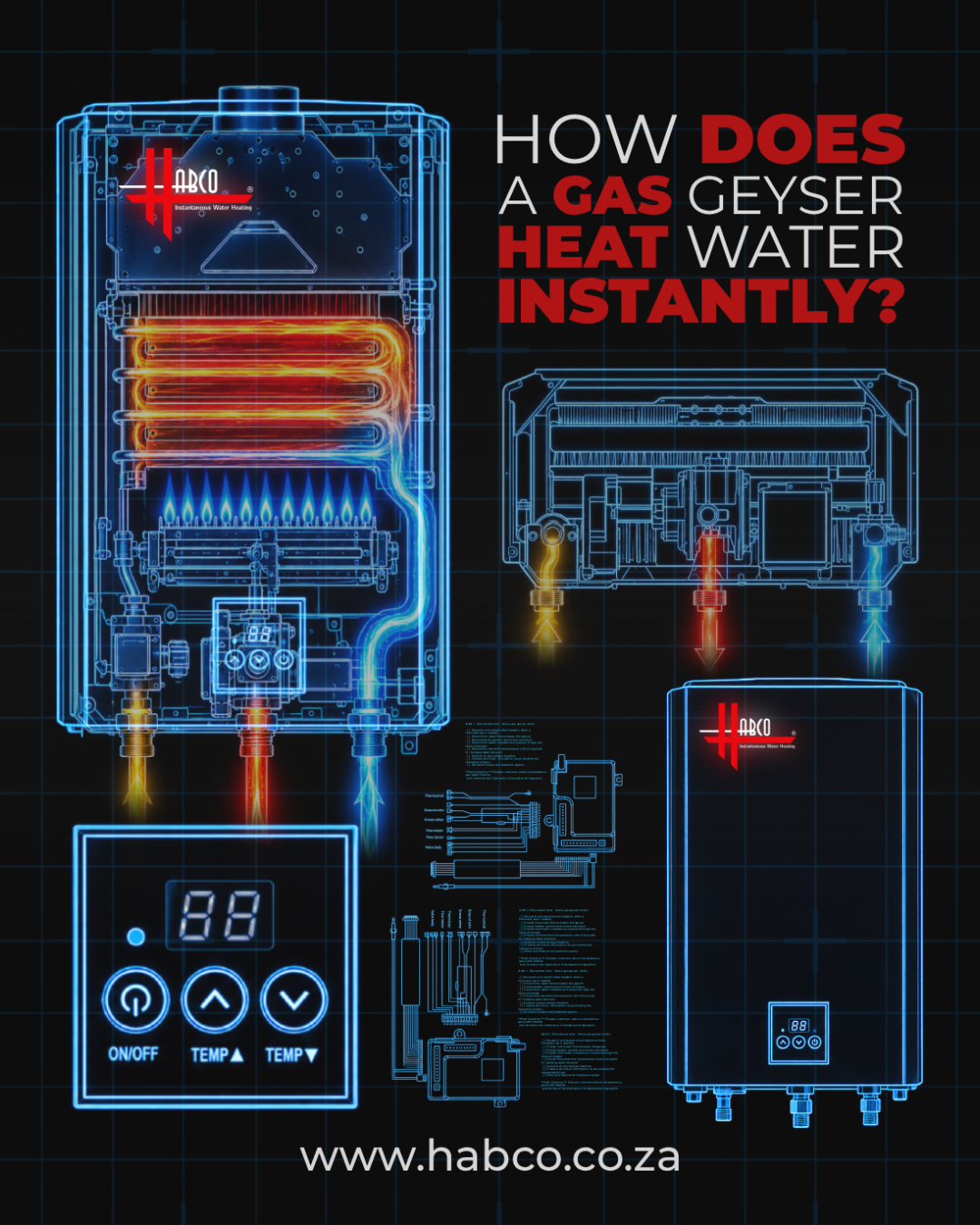
Unlike a conventional storage geyser, an instantaneous gas water heater doesn't keep a large tank of water heated and waiting. It heats water as it passes through the appliance.
Here's how it works.
1. The tap opens. Cold water enters the geyser through the water inlet.
2. Water flow is detected. An internal flow sensor recognises that water is moving through the system and activates the heating sequence.
3. Automatic ignition begins. The ignition system lights the gas burner, producing the heat needed to warm the incoming water.
4. Heat transfer takes place. Water travels through the heat exchanger, where heat from the burner is transferred to the flowing water.
5. Hot water is delivered. The heated water exits through the hot water outlet and travels to the open tap or shower.
Close the tap, and the water flow stops. The burner switches off.
And here's something interesting: because there is no large storage tank to keep reheating, the system heats water when it is needed rather than maintaining a tank of hot water around the clock.
But instantaneous hot water is only part of the story.
What happens when water demand changes? When another tap opens, or someone starts using hot water elsewhere in the home, temperature regulation becomes important.
That's where technology takes the next step.
Tomorrow, we'll look at one of the clever little powerhouses in the HABCO range: the 18L Constant Temp 3V. A smarter approach to controlling your hot water temperature.
Want to explore the HABCO range or find the right capacity for your home?
Visit www.habco.co.za
Follow HABCO for practical gas geyser knowledge, technology and advice.
Maintenance & performance
7 ways to get the best from your gas geyser
· HABCO South Africa
Getting the best performance from your HABCO geyser isn't only about the geyser itself. A few simple adjustments around your home can make a noticeable difference to your hot water experience, energy use and overall performance.
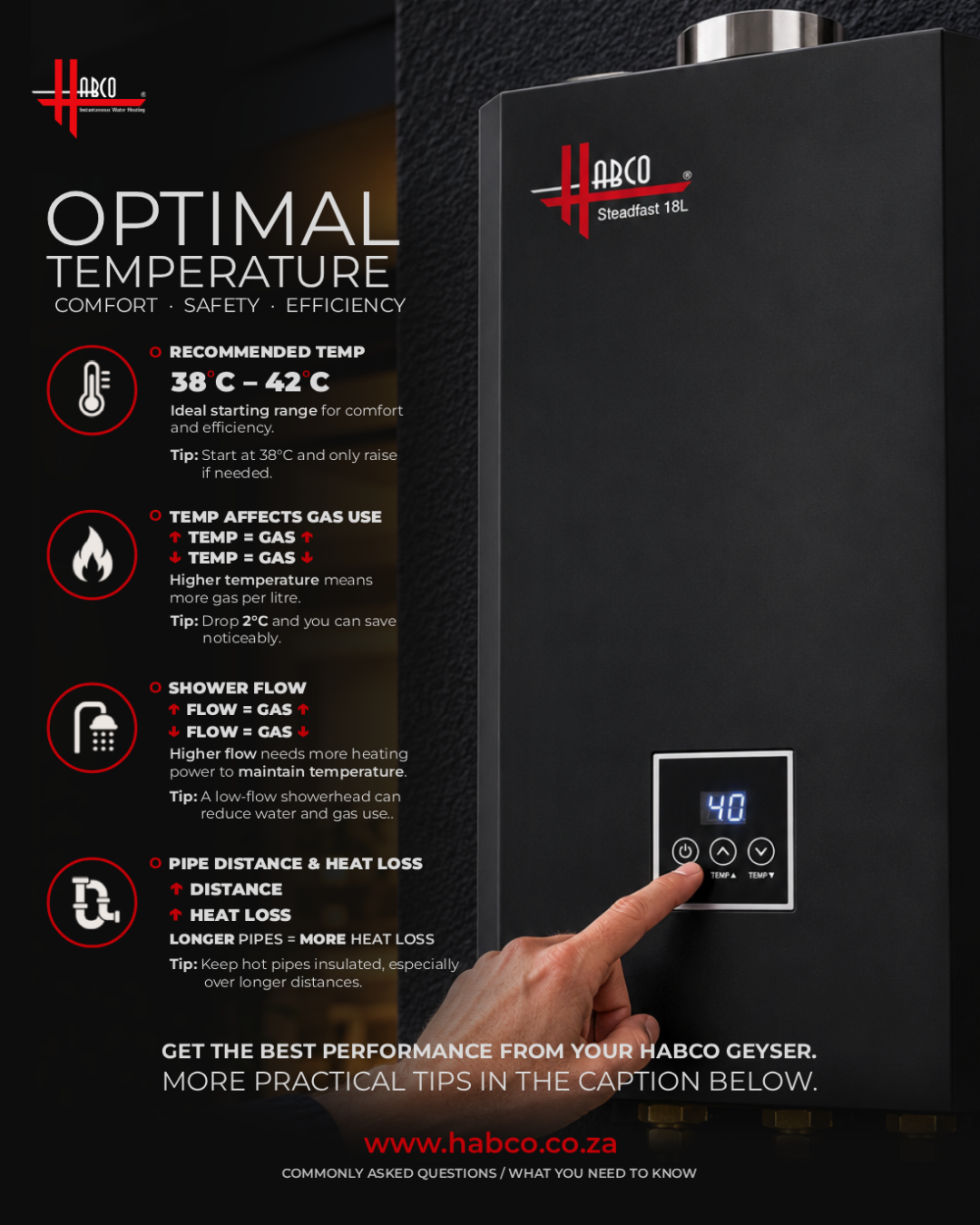
Here are 7 practical ways to get the best out of your gas geyser.
1. Set your water temperature correctly
A starting temperature of around 38–42°C is generally comfortable for everyday use. Setting the temperature unnecessarily high can mean using more gas and adding cold water to bring it back down.
2. Understand how water flow affects performance
Your geyser heats water as it flows through the unit. Higher water demand means the geyser has to work harder to maintain the required temperature. If several outlets are used at the same time, you may notice a change in temperature or flow.
3. Keep showerheads and filters clean
Limescale and dirt can restrict water flow through showerheads, tap outlets and inlet filters. Regular cleaning helps maintain consistent water flow and allows your geyser to operate as intended.
4. Insulate your hot water pipes
Long or exposed hot water pipes can lose heat before the water reaches your tap or shower. Pipe insulation helps reduce heat loss, particularly where pipes run outside or through colder areas.
5. Maintain a stable LPG supply
Your geyser needs a suitable and consistent gas supply to perform correctly. Incorrect gas pressure, undersized pipework or a low gas supply can affect heating performance.
6. Service your geyser regularly
Like any gas appliance, your geyser needs proper maintenance. Regular servicing helps identify potential issues, keeps components in good condition and supports safe, reliable operation.
7. Keep the installation area clear
Make sure the area around your outdoor geyser remains clear. Ventilation openings and the exhaust outlet must never be obstructed. Always keep the installation compliant with the manufacturer's requirements.
Small adjustments can make a big difference.
www.habco.co.za
Safety & replacement
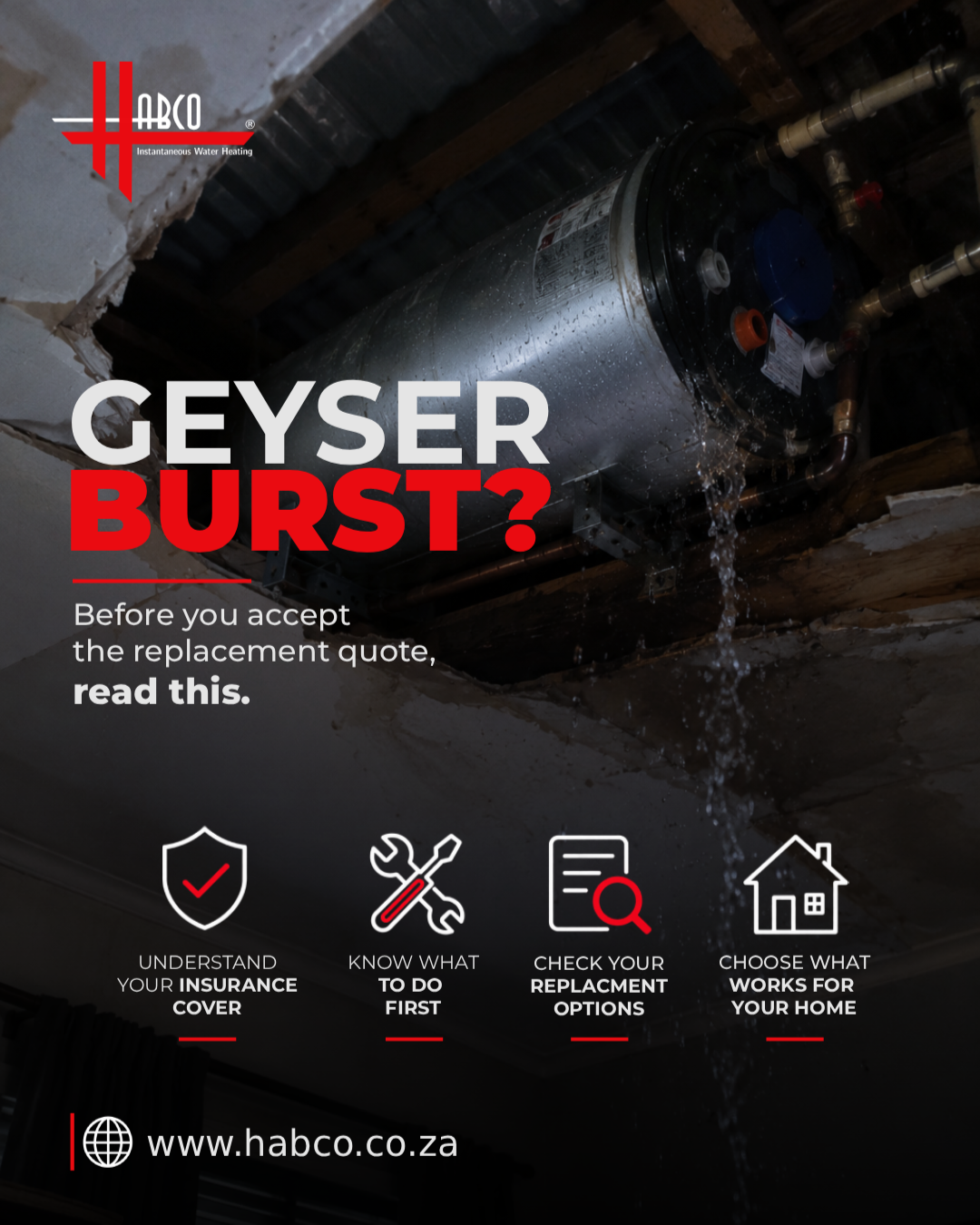
If your geyser burst tomorrow
· HABCO South Africa
A burst geyser can cause far more than a plumbing problem. Water damage can affect your ceilings, floors and belongings, while the insurance claim and replacement costs leave you with decisions to make quickly.
If your geyser burst tomorrow, would you know what to do first?
Here are five things every South African homeowner should know before facing a geyser replacement.
1. FIRST, LIMIT THE DAMAGE
Keep clear of wet electrical areas and unsafe ceilings. If it's safe, shut off the water supply and switch off the geyser's electrical supply at the distribution board. Never enter a wet roof space.
Contact a plumber and notify your insurer. Photograph the damage where safe, and keep records of what happened.
2. DOES THE WHOLE GEYSER NEED REPLACING?
Not every fault requires a new geyser. A thermostat, heating element or valve may be repairable, but a leaking tank caused by corrosion will usually need replacing.
Here's a useful technical detail: many conventional storage geysers contain a sacrificial anode that helps protect the steel tank from corrosion. It gradually wears down, which is why following the manufacturer's maintenance recommendations matters.
If your geyser is relatively new, check its warranty before agreeing to a replacement.
3. CHECK YOUR GEYSER INSURANCE AND EXCESS
Your insurance excess, policy limits and the cause of the failure can all affect your claim. Sudden damage may be treated differently from gradual deterioration, rust or wear and tear.
Ask whether your insurer needs to inspect the damaged geyser before removal, whether you must use an appointed service provider, and what photographs or documents are required.
Remember, damage to ceilings, flooring and belongings may be assessed separately from the geyser itself.
4. WHAT DOES "LIKE FOR LIKE" MEAN?
"Like for like" generally means replacing the damaged item with something of a similar type and specification, rather than automatically paying for an upgrade.
You may also encounter the term "betterment", which refers to improving or upgrading something beyond its previous standard.
Insurance terms vary, so check your own policy before committing to a replacement.
5. COMPARE THE COMPLETE REPLACEMENT QUOTE
Two geyser replacement quotes can look similar but cover very different things.
Check whether the price includes the geyser, labour, removal, installation materials, valves and additional work. For conventional electric storage geysers, SANS 10254 requirements may affect what needs attention, depending on the installation.
Ask what's included, what's excluded and why extra work is necessary. The cheapest quote isn't always the cheapest job.
FINALLY, CHOOSE WHAT WORKS FOR YOUR HOME
A burst geyser is stressful, but it can also be an opportunity to reconsider your hot-water options rather than automatically replacing like for like.
Consider your household's hot-water needs, installation requirements and total cost. If you're weighing up an electric vs gas geyser, make sure the system and installation location are suitable for your property.
HABCO offers outdoor LPG gas geysers in different models and capacities, giving you options to explore when considering an alternative.
Explore the HABCO gas geyser range: https://habco.co.za/
Hopefully, your geyser keeps working for years to come. But if it fails, you'll know what to check, what questions to ask and what to consider before spending your money.
Solar & off-grid
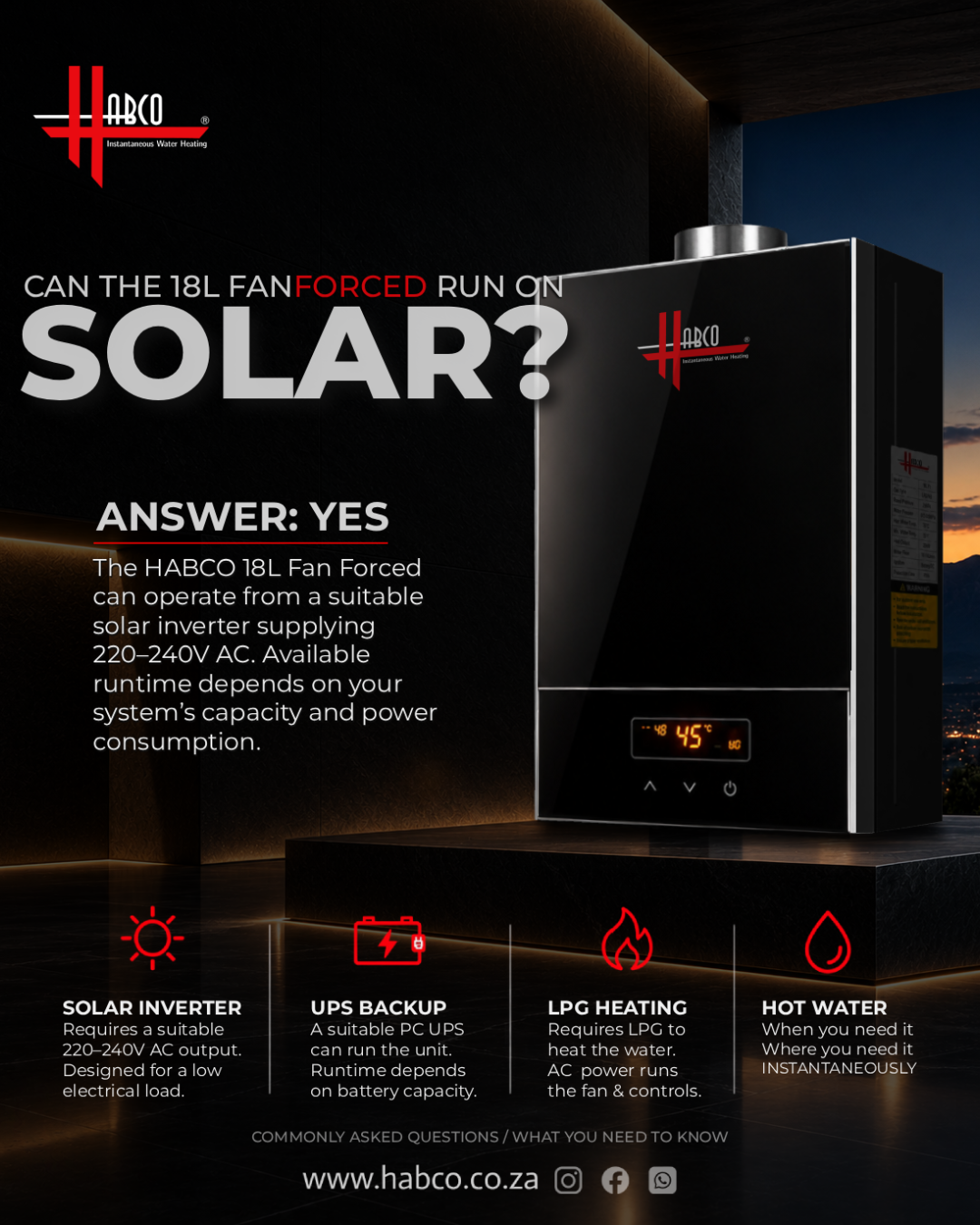
Can the 18L Fan Forced run on solar?
· HABCO South Africa
Welcome to HABCO's Commonly Asked Questions series! We'll be sharing helpful answers to questions about our products to help homeowners understand their options and make informed decisions about hot water for their homes.
Let's kick things off with a question we often hear:
Can the HABCO 18L Fan Forced run on solar?
It is possible with a suitable inverter supplying 220–240V AC.
Here's the good news: LPG does the actual water heating, so electricity is only needed to run the fan and electronic controls. In other words, you're using gas to heat the water, not electricity.
One important factor to consider is runtime. This depends on your inverter's output, battery capacity and the power available from your system. Some customers have reported getting up to an hour of runtime using a standard 2000VA PC UPS. While this isn't guaranteed for every setup, it's a practical example of how the unit can provide hot water during a power outage without relying on electricity to heat the water.
Not sure whether your solar or backup power system is suitable? Send us a message or give our office a call. We'll gladly discuss your setup and help you explore your options.
For general enquiries:
011 900 1421
Monday–Friday, 08:00–16:30
Visit www.habco.co.za for more product information.
Solar & off-grid
Solar growth and off-grid hot water
· HABCO South Africa
South Africa's solar boom is changing the way we think about energy.
Between July 2022 and June 2026, South Africa's estimated behind-the-meter (rooftop and private) solar PV capacity grew from about 2.26 GW to about 9.11 GW, according to National Transmission Company South Africa (NTCSA) system status reports. That is more than a fourfold increase in less than four years. These figures describe estimated private, mainly rooftop capacity that does not feed the grid under a formal NTCSA contract — not total national solar generation capacity.
But generating electricity is only part of the equation. If you've already invested in solar, or are planning to go solar or move towards off-grid living, it's important to consider whether your system can meet your household's energy needs throughout the year.
In 2022, Statistics South Africa estimated household energy use per capita at 12.0 gigajoules per person. That figure covers all household energy uses (not electricity alone) and is calculated from total resident household energy use divided by the resident population.
One important part of those needs is water heating. It accounts for a significant share of household energy use, and demand can change considerably with the seasons. Research on domestic hot-water consumption in Johannesburg (Meyer and colleagues) found that average hot-water use increased by about 70% from summer to winter in the houses studied. That result is specific to those measured dwellings and should not be generalised to every South African household without further data.
That's why energy efficiency matters. Getting more from your solar system isn't always about generating more electricity. It can also mean finding smarter ways to meet your household's needs while reducing the demand placed on your system.
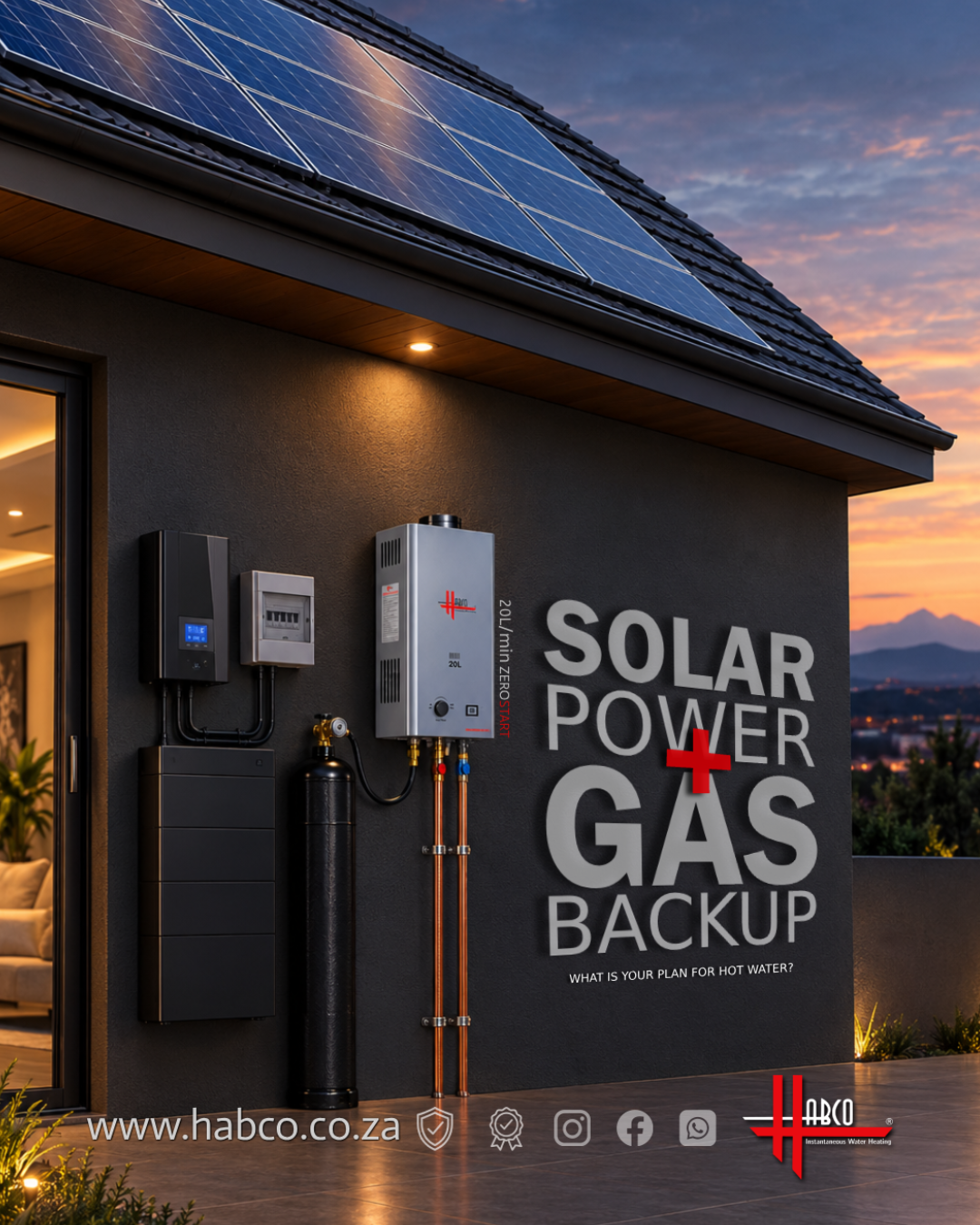
At HABCO, we believe water heating deserves a place in that conversation. This week's product spotlight is our Zero Start range. With off-grid ignition, it offers a practical hot-water solution for solar-powered and off-grid homes.
By using LPG gas to heat your water, you can reduce the demand water heating places on your solar electrical system, leaving more electricity available for other household needs.
What's your plan for hot water?
Sources and further reading
- NTCSA — Weekly System Status Reports (estimated behind-the-meter / rooftop PV capacity). July 2022 ≈ 2,264.5 MW; June 2026 ≈ 9,107.4 MW. See e.g. ntcsa.co.za system status publications.
- Statistics South Africa — Physical Energy Flow Accounts for South Africa, 2022 (Discussion Document D0401.7). Household energy use per capita 12.0 GJ (2022). statssa.gov.za
- Meyer, J.P. et al. — Domestic hot-water consumption studies in Johannesburg (houses and related dwelling types). Reported ~70% summer-to-winter increase in measured houses. See e.g. review summary in Journal of Energy in Southern Africa / related publications.
Solar & off-grid
Solar-to-gas diverter valve
· HABCO South Africa
Solar water heating is a clever way to use the sun's energy for everyday hot water. But what happens when the sun hasn't provided enough heat, or your household uses more hot water than the system has stored?
If you already have solar, there are ways to get more from your setup. And if you're planning a solar installation, it's worth understanding your options.
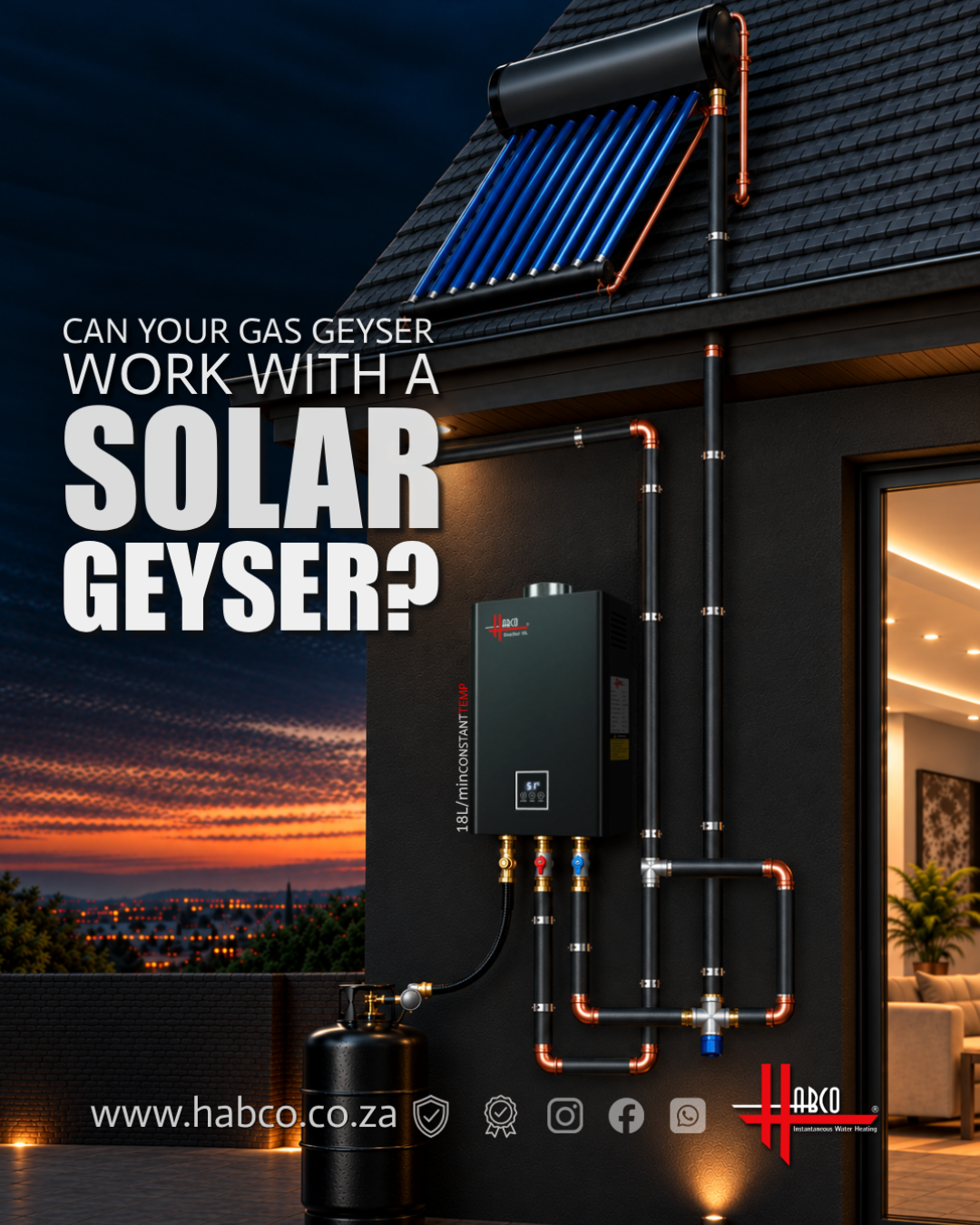
One solution is a solar-to-gas diverter valve, which combines solar water heating with gas backup.
Solar collectors capture heat from the sun and transfer it to water stored in a tank. That heat is available later, but it isn't unlimited. Showers and other hot water use gradually replace hot water with colder water, while heat is also lost through the tank and pipes. Cloudy weather, tank size and household demand all affect how much hot water is available.
This is where the diverter valve comes in.
The thermostatic valve responds to the temperature of the water leaving the solar system. When the water is hot enough, it flows directly to the house, bypassing the gas geyser. When it cools below the valve's set temperature, the valve diverts it through the gas geyser for additional heating.
Depending on the valve, this changeover may be set around 45°C or 50°C.
Instead of relying entirely on stored solar heat, you have a system that can make use of that heat first, with gas providing additional heating when needed. And because warmer water requires less energy to reach the desired temperature, the gas geyser may need to do less work.
For existing solar owners, it's an option worth exploring. For anyone planning a new system, it's another way to think about keeping hot water available through changing weather and household demand.
Water flow & pressure
Water pressure: have you got enough?
· HABCO South Africa
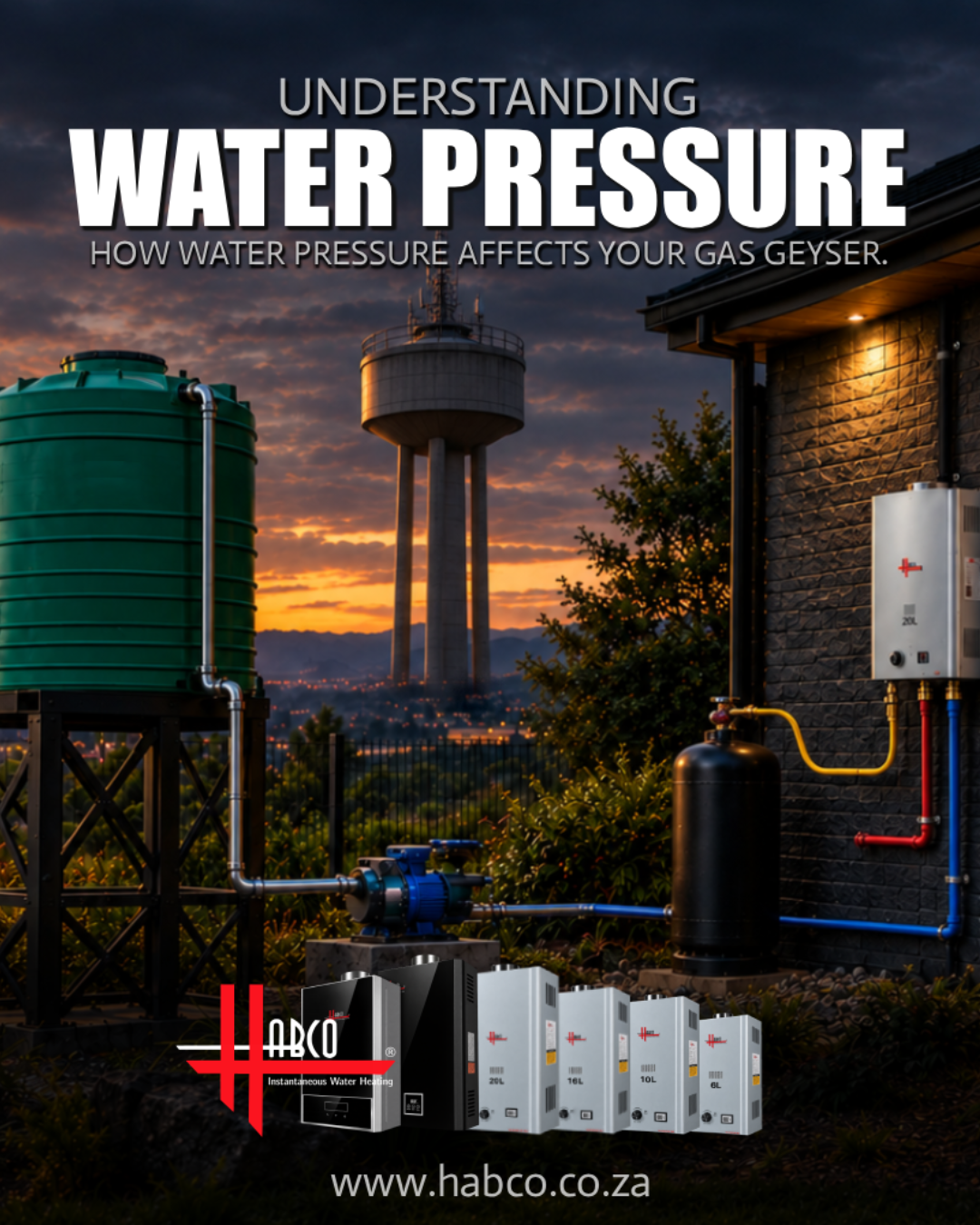
WATER PRESSURE: HAVE YOU GOT ENOUGH?
A borehole, a water tank or a municipal connection can supply your home with water. But will it provide enough pressure for your gas geyser?
Here's what you need to know.
MUNICIPAL WATER
Most homes in Gauteng should have sufficient municipal water pressure for a gas geyser, but pressure can vary depending on your area and supply conditions. It's always worth checking the requirements for the specific model you're considering.
WATER TANKS
Water pressure comes from the height of the water above your geyser. As a rough guide, every metre of vertical water head provides about 0.1 bar of pressure (more precisely ≈0.098 bar per metre for water). Pipe friction and fittings reduce the pressure available at the geyser, so the static head figure is only a starting point.
For the HABCO models shown, the minimum inlet pressure is around 0.25 bar for Zero Start and 0.15 bar for the 18L Fan Forced. That corresponds to roughly 2.5 m and 1.5 m of water head respectively, before allowing for pressure losses. The important measurement is the water level above the geyser, not just the height of the tank stand.
BOREHOLES AND PUMPS
A borehole doesn't automatically guarantee enough pressure. The pump needs to suit the borehole's yield and your household's water demand.
If gravity alone can't provide enough pressure, a suitable pressure or booster pump may be needed. The right setup depends on your water source, pipework and how many taps or showers you use at the same time.
For more information about HABCO gas geysers:
011 900 1421
083 657 3924
www.habco.co.za
Sources and further reading
- Hydrostatic pressure: approximately 0.098 bar per metre of water head (standard conversion). Allow for pipe and fitting losses in any real installation.
- Minimum inlet pressures stated for HABCO models are taken from current HABCO technical specifications.
Water flow & pressure
Measure your hot-water flow rate
· HABCO South Africa
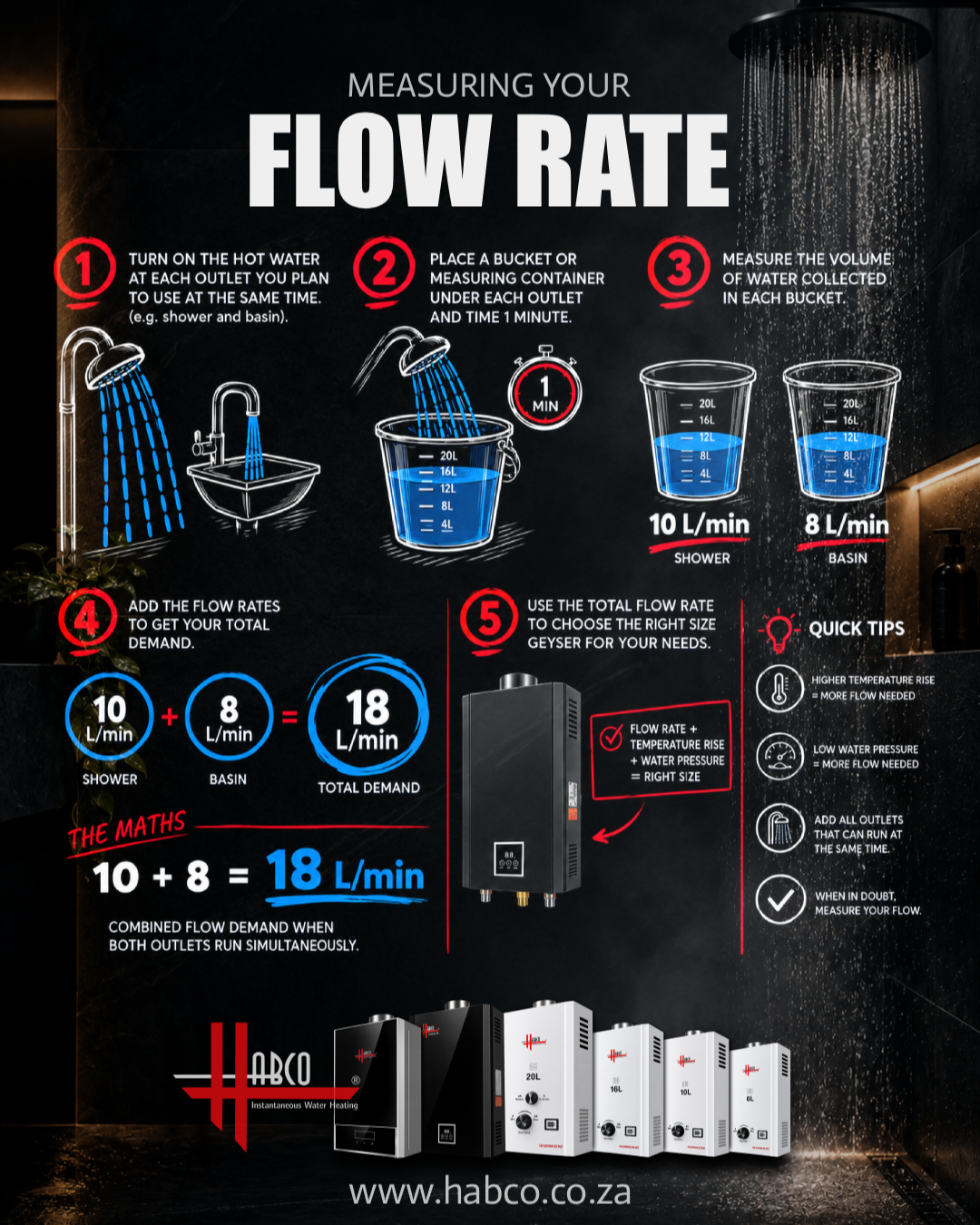
Yesterday, we looked at how the number of bathrooms and your household's usage help determine the right gas geyser size. Today, let's take it a step further and measure your actual hot-water flow rate.
Here's a simple way to get a clearer picture of your demand.
Grab a bucket with litre markings (a 10-litre bucket is a practical choice) and a timer. Run your shower at your usual temperature and flow, then collect the water for a measured period.
Check how many litres you collected and calculate the flow rate in litres per minute.
For example, collecting 6 litres in 20 seconds works out to 18 litres per minute. The calculation is litres collected ÷ seconds taken × 60.
If you use more than one hot-water outlet at the same time, measure their combined flow while they're running together. This helps you understand the demand your geyser may need to handle.
Your flow rate is an important piece of the puzzle, but the right model also depends on its specifications and operating requirements.
Follow HABCO for more practical guidance on choosing the right gas geyser for your home.
Need help? DM us or contact HABCO.
011 900 1421
083 657 3924
www.habco.co.za
Geyser sizing & selection
Choosing the right size gas geyser
· HABCO South Africa
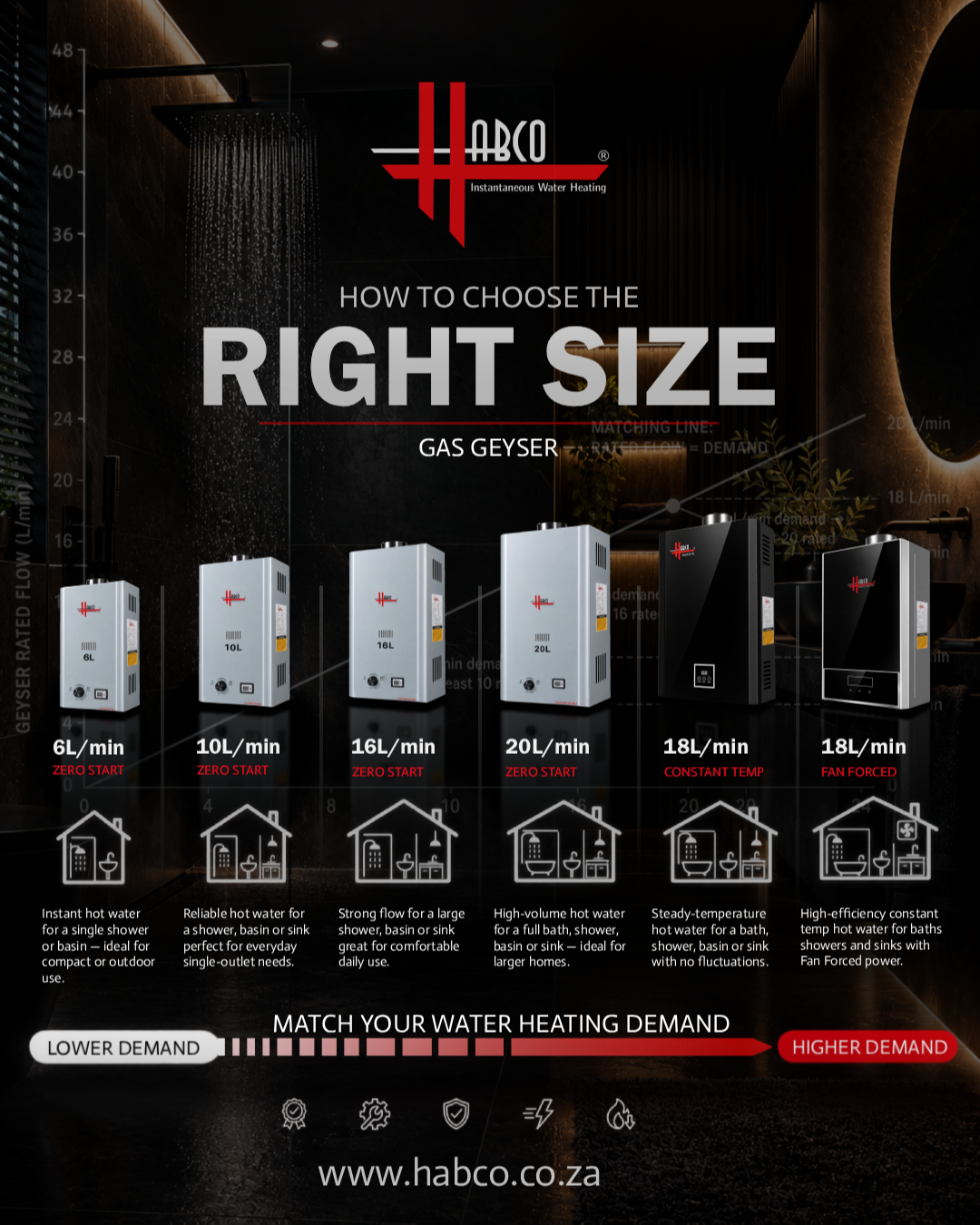
Choosing the right size gas geyser starts with understanding your household's hot water needs.
How many bathrooms do you have? How many showers, basins and kitchen outlets need hot water? And could more than one shower be running at the same time?
As a starting point, more bathrooms and outlets can mean greater hot water demand. Choosing a geyser that's too small may leave you struggling when several outlets are used together, while the aim is to match the unit to your household's actual needs.
HABCO offers a range of models for different household requirements, from single-outlet applications to homes with multiple bathrooms.
Tomorrow, we'll look at flow rate and why it matters when choosing the right size.
Not sure which model suits your home? DM us or contact HABCO for guidance.
011 900 1421
083 657 3924
www.habco.co.za
Getting more from your gas bottle
· HABCO South Africa
Getting more from your gas bottle isn't always about using less gas. It's about making sure the energy you're paying for isn't going to waste.
Earlier this week, we looked at gas geyser consumption rates and choosing the right bottle size for your household. But once you've got the right setup, there are a few simple ways to make that LPG go further.
Here are four practical things worth looking at.
The figures below are based on published testing and practical examples. Actual results will vary depending on your appliance, water usage and installation.
1. Make your shower more efficient
A showerhead can make a surprisingly big difference. South African testing by CLASP (2022) found that 58% of the showerheads tested were fixed-orifice types and delivered an average of about 27 litres per minute when tested at 300 kPa. Pressure-compensating models in the sample delivered much lower, more consistent flow rates (often in the region of about 6–9 L/min at the same test pressure). These are test results from a market sample, not a claim about every showerhead sold in South Africa.
Over a five-minute shower, moving from a high-flow fixed-orifice head towards a lower-flow pressure-compensating option can save a large volume of water that would otherwise need heating — potentially on the order of 80–100 litres in a high-flow versus low-flow comparison. Actual savings depend on your existing head, pressure and shower habits.
Water-saving showerheads and flow regulators are widely available and often inexpensive. Just check that they're compatible with your geyser's minimum operating flow.
2. Think about how much hot water you actually use
A typical bath uses around 80–150 litres of water. Compare that with a five-minute shower at 7.5 litres per minute: just 37.5 litres.
So, shower or bath? Those numbers might help you decide!
And if you don't need hot water, use the cold tap. Even turning on the hot tap can activate your geyser once enough water flows through it, which could mean water getting heated even if you don't use it.
3. Make sure you're getting safe, quality LPG
Underfilled cylinders, illegal refilling and contaminated LPG are known problems. Substances such as water or paraffin can be introduced into gas, affecting its quality and combustion.
This is about more than getting the LPG you paid for. Poor-quality or contaminated gas can affect your geyser's performance, damage internal components and create potentially dangerous operating conditions. It can become a safety concern for both your appliance and your household.
Always buy from reputable, authorised suppliers. Check that the safety seal matches the cylinder branding.
You can also check the weight. A cylinder with a 12 kg tare weight and a 19 kg refill should weigh approximately 31 kg when full. If you're paying for 19 kg of LPG, you should be getting 19 kg.
4. Give your gas geyser some attention
Like a car engine, a gas geyser needs regular maintenance to keep performing properly. Dirty burners, blocked injectors and worn components can affect combustion and efficiency.
Follow the manufacturer's service recommendations. An annual service is a sensible general guideline, using an appropriately registered gas practitioner.
These are four of our top tips for getting more from your LPG and reducing gas consumption around the home.
There's one more important factor: your geyser's temperature setting. It can also have a noticeable effect on LPG consumption. We covered finding the optimal temperature in last week's post along with a few more tips to help get the most out of your gas appliance.
You can have a look here:
https://www.facebook.com/share/p/1JaSY7HA59/
Small changes can add up. Which of these tips have you tried at home?
For more information about LPG, gas geysers and the HABCO range, visit www.habco.co.za
Sources and further reading